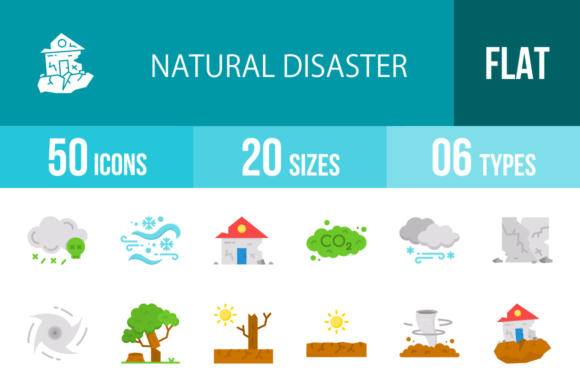
Visualizing Climate Chaos: The 50 Natural Disaster Flat Multicolor Icon Set
Why Visualizing Risk Matters in Modern Design
In an era defined by climate volatility and environmental shifts, effective communication is paramount. Whether you are a climate researcher presenting data, a non-profit organization launching an awareness campaign, or a news outlet covering a breaking weather event, the ability to convey complex, often terrifying concepts instantly is a massive challenge. This is where the 50 Natural Disaster Flat Multicolor Icon set steps in. It bridges the gap between abstract threats and tangible understanding through clean, immediate visual language.
As a designer or content creator, you know that stock photography can sometimes feel staged or overwhelming when dealing with sensitive topics like destruction. Icons offer a cleaner, more abstract way to represent these events without the gore or emotional weight of a photograph. This specific collection provides a robust vocabulary for everything from meteorological phenomena to geological shifts. It is not just a set of pretty pictures; it is a functional toolkit for modern typography and visual storytelling, specifically tailored for the urgent subject of natural disasters.
Anatomy of the Set: Style, Personality, and Usability
The visual character of the 50 Natural Disaster Flat Multicolor Icon collection is defined by its adherence to the "ungird" system—a structured grid that ensures geometric harmony across all 50 symbols. This design choice results in a highly cohesive brand identity if you choose to use the full set. The style is distinctly "flat," meaning there are no drop shadows, bevels, or complex gradients. This minimalist approach ensures that the icons render crisply on any resolution, from a high-DPI retina display on a smartphone to a standard definition projector screen during a presentation.
What makes this set particularly versatile is the "Multicolor" aspect. Unlike monochromatic line icons that can sometimes fade into a busy background, these icons utilize a vibrant, modern palette. The colors are not arbitrary; they are chosen to intuitively represent the elements. Blues and greys for water-based disasters like the Tsunami, Flood, and Heavy Rain; warm oranges and reds for the Fire, Volcano, and Lava icons; and stark yellows and blacks for warnings and hazards. This color coding aids in rapid cognitive processing—a user can glance at the Earthquake or Cyclone icon and understand the category of threat before reading a single word.
From a technical standpoint, the utility is undeniable. The set includes six different formats: AI, CDR, EPS, JPG, PNG, SVG. For the web designer, the SVG format is a goldmine, allowing for infinite scalability without pixelation, which is crucial for responsive web design. For the graphic designer working in print, the vector AI and EPS files ensure that your brochures or posters maintain sharp edges regardless of size. The inclusion of JPG and PNG makes it accessible for entrepreneurs and bloggers who may not have advanced vector editing software but need quick assets for social media graphics.
Strategic Applications: From Mobile Apps to Editorial Design
The true value of a premium font or icon set lies in its application. The 50 Natural Disaster Flat Multicolor Icon set is designed for maximum usability across a spectrum of industries. Let’s break down where these assets will have the most impact.
Digital and Mobile Interfaces
For mobile apps focused on weather forecasting, emergency preparedness, or news reporting, clarity is a matter of safety. A user looking for information on a Sandstorm or Blizzard needs to find it immediately. These icons work beautifully as navigation elements, tab bar icons, or notification indicators. Because they are designed on a grid, they align perfectly with standard UI elements, ensuring a professional, polished look that builds user trust. The Shelter and Warning icons are particularly useful for "Call to Action" buttons in emergency apps.
Publishing and Editorial Layouts
In editorial design, specifically for magazines or educational textbooks discussing climate change, these icons serve as excellent sidebars or pull-quote markers. Imagine an article about Global Warming or the Greenhouse Effect. Instead of generic bullet points, using the specific icons for CO2, Pollution, or Glacier melting adds a layer of thematic depth to the layout. They break up long blocks of text and provide visual breathing room, improving readability and keeping the reader engaged.
Corporate and Educational Branding
For NGOs, insurance companies, or environmental consultants, visual consistency is key. Using these icons in templates for PowerPoint presentations or packaging design for educational kits helps reinforce a message of preparedness and awareness. The Seismograph and Volcano icons can be used in logos or sub-marks for geology departments or specialized engineering firms. The flat style pairs exceptionally well with sans serif font families, creating a modern, clean aesthetic that feels authoritative yet approachable.
Design Mechanics: Integration and Font Pairing
Icons do not exist in a vacuum; they must coexist with typography. When integrating the 50 Natural Disaster Flat Multicolor Icon set into your work, consider the interplay between the icon’s weight and your chosen typeface.
Because these icons are flat and geometric, they pair best with sans serif font families that share similar geometric qualities. Think of typefaces like Montserrat, Roboto, or Open Sans. The clean lines of the text will mirror the clean lines of the icons, creating a unified visual hierarchy. If you are designing a poster for a fundraiser, you might use a bold display font for the headline, but keep the supporting text and icon labels in a legible, standard weight to ensure the message isn't lost.
Avoid pairing these specific flat, colorful icons with overly ornate script font or handwritten font styles for functional text. While a creative font might look nice for a title, using it for navigation labels next to these sharp icons can create a visual clash that confuses the viewer. The goal is readability. The icons provide the color and visual interest; your typography should provide the structure and legibility.
Practical Considerations for Implementation
Before you drop these assets into your next project, there are a few practical checks to perform to ensure you are getting the most out of this design asset.
- Color Harmony: While the icons come with a preset palette, the SVG and AI files are fully editable. If your brand identity uses specific hex codes, take the time to adjust the icon colors to match. A Wildfire icon in your brand’s specific shade of orange looks far more professional than a generic stock red.
- Contextual Relevance: Be mindful of the specific icon you choose. There is a difference between a Hurricane and a Typhoon, or a Dust Storm and a Sandstorm. Ensure the icon matches the specific terminology used in your content to maintain credibility.
- Spacing and Padding: Even though these are designed on an "ungird" system, you need to account for optical spacing when placing them next to text. Ensure there is enough padding around the icons so they don't crowd your typography.
Ultimately, the 50 Natural Disaster Flat Multicolor Icon set is more than just clip art. It is a sophisticated communication tool. For the marketer, it adds emotional weight to a campaign about sustainability. For the app developer, it provides essential clarity for user interfaces. For the educator, it turns abstract data into understandable concepts. By leveraging the vector formats and the cohesive design language, you can elevate your project from a simple layout to a compelling, professional narrative about the world we live in.